
WTF Are Based Rollups?

If you've listened to any of the L2 debates then you've no doubt heard reference to "Based" rollups.
These are different than "Optimistic" and "Zero Knowledge (ZK)" rollups because they're considered more synergistic with mainnet Ethereum.
Here's why that is (with pictures).
We'll start from the beginning (vocabulary - I promise it's short 😅), touch on "normal" blockchains and finish with the Based™️ construction itself
Glossary
First, lets go over a couple terms and key roles so we don't have to waste time Googling stuff.
ROLES
Sequencer: The single machine run by L2 teams responsible for collecting user transactions and determining the sequence they're packed in to L2 blocks and ultimately batched and submitted to the L1.
Block Builders: These players are a piece of the sequencer-equivalent assembly line on mainnet Ethereum. These entities receive user transactions (either publicly or privately), maximize for profit through particular sequencing and ultimately pass them on to validators to be formalized in to blocks.
TERMS
Base Fee: This is the minimum amount users pay to get in to any given block with pricing determined by congestion. (e.g. If block 10 has >50% gas utilization then block 11 goes up in minimum cost). This fee is burned on Ethereum and on some L2s.
Priority Fee: This is the "tip," or extra money you're willing to pay, on top of the base fee to get priority ordering in the block (i.e. you're the first tx executed in a given block)
If you grasp the above, you'll be able to follow along and understand why Based rollups are meaningfully different than what we're used to.
Ethereum Blocks
To set the foundation, lets talk how Ethereum blocks are created and which of our glossary items matter.
A visual:
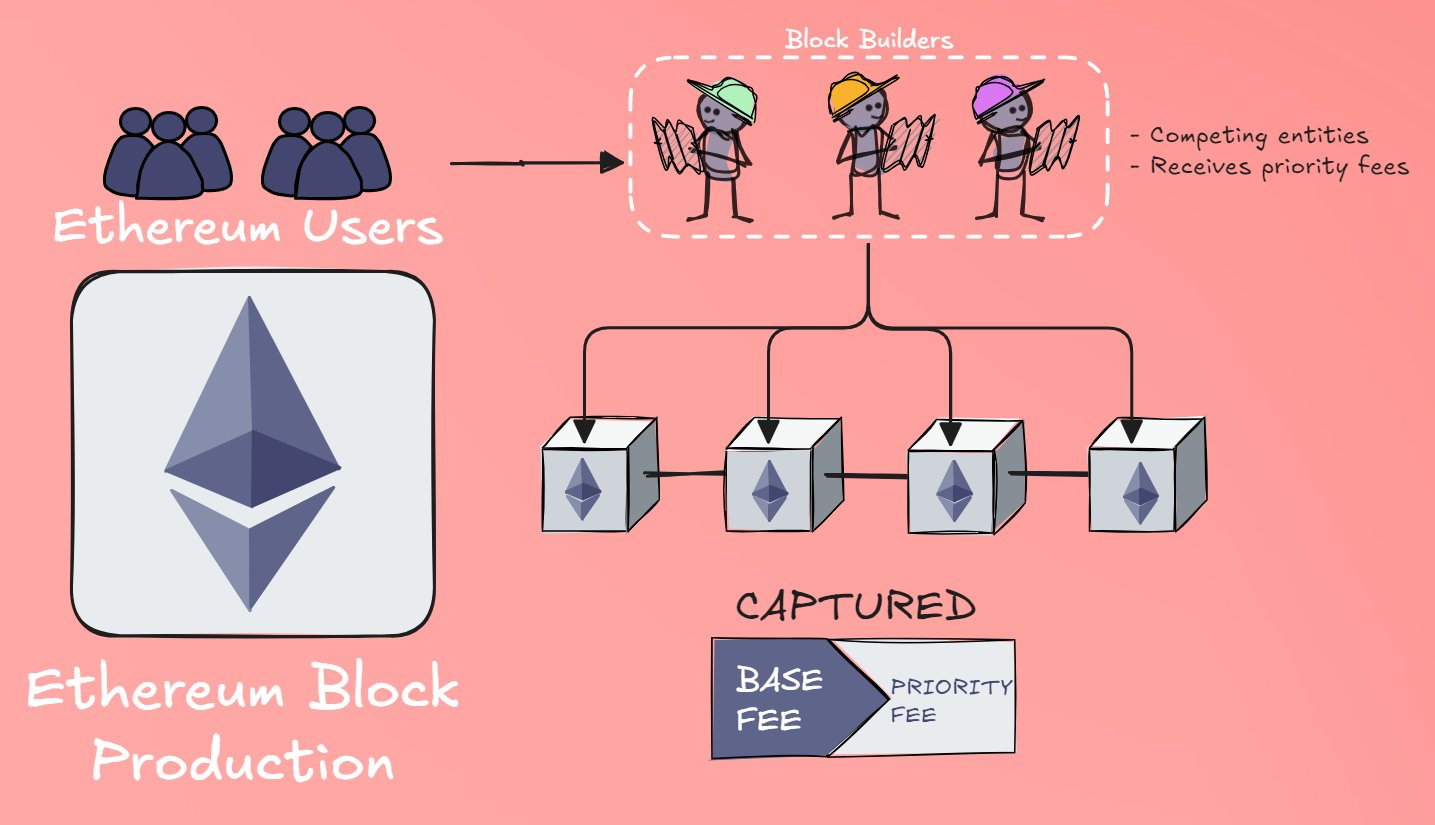
Now lets talk through the flow:
Ethereum users submit their transactions to Builders
These transactions denote the user's maximum fee, which will cover the Base Fee (burned) for inclusion and use the remaining fee delta as the Priority Fee/Tip (kept by Builders)
Builders then give these blocks to Validators, which are submitted for inclusion to the canonical chain
In the end, 100% of the fees paid by the user is captured by either $ETH the asset (by way of burning) or participants in the Ethereum block building supply chain (Builders, here).
The former mechanism is seen as an agnostic alternative to direct public goods funding while the latter provides incentives for a key component of the Ethereum block building process. Both (generally) seen as value-accretive to the network writ large.
Now lets look at your typical L2.
Traditional Rollup Blocks
Focusing on Optimism as our example, we can keep the same relative structure as Ethereum and just swap out Builders (a collective of competing entities) for Sequencer (a single machine run by the team behind Optimism).
Visualized:
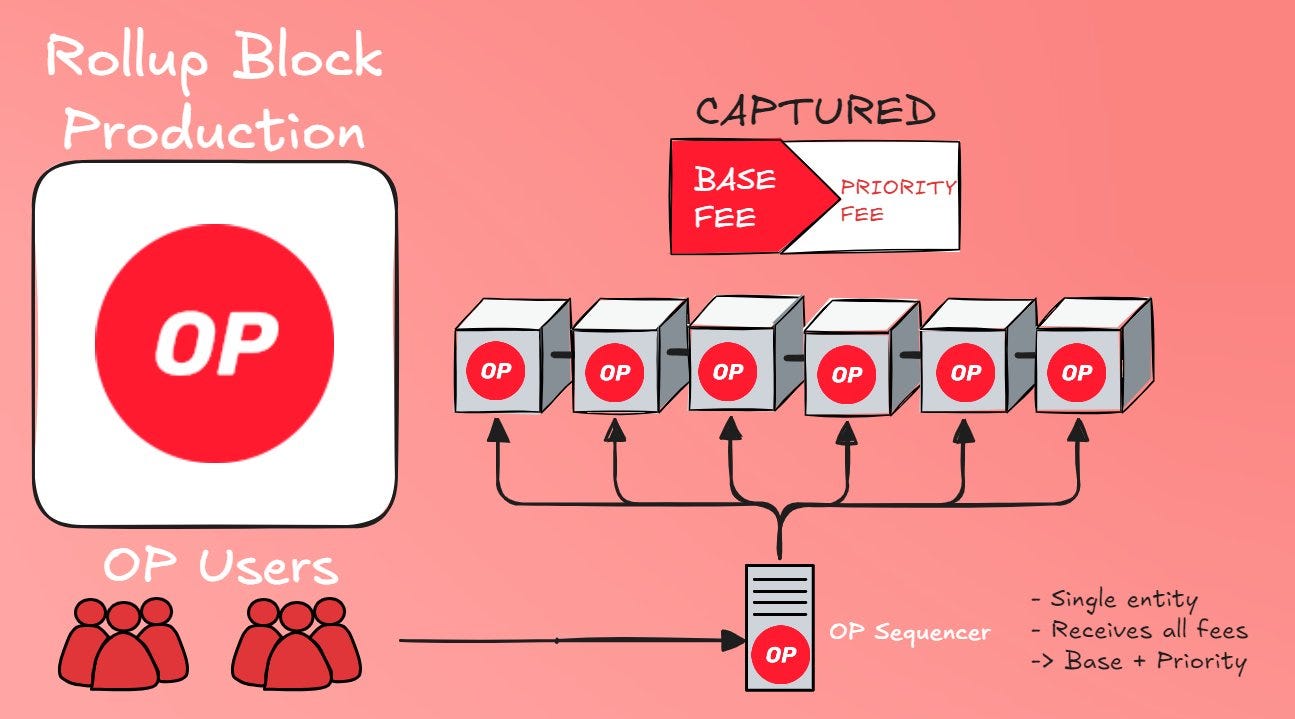
Again, walking through the flow you'll see they're pretty similar:
Optimism users submit their transactions to the OP Sequencer
Like Ethereum, these transactions will state the user's maximum fee, covering the Base Fee (OP Stack chains burn this, but not all L2s do [e.g. Arbitrum]) for inclusion and use the remaining fee delta as the Priority Fee/Tip (kept by team running sequencer)
Sequencer then sequences the transactions, proposing the next block to the canonical chain and updating the L2 state/world view to mainnet Ethereum
The thing to note here is that the end user relationship and 100% of their fees go to the sequencing entity (i.e. they stay in the L2 ecosystem). What that entity, whether it's Optimism, Base, Arbitrum or Blast, does with the fees is entirely at their discretion.
- Some will burn the base fee and pocket the priority fee (Base).
- Some will give both to token holders (Arbitrum).
- Others will give a portion of funds back to developers on the chain (Blast).
"But BREAD, if the L2 captures all of those fees then how does Ethereum benefit?" - You (just now)
Well, lets talk about how these two block building processes tie together...
Traditional Rollup + Ethereum Blocks
As always, a visualization first:
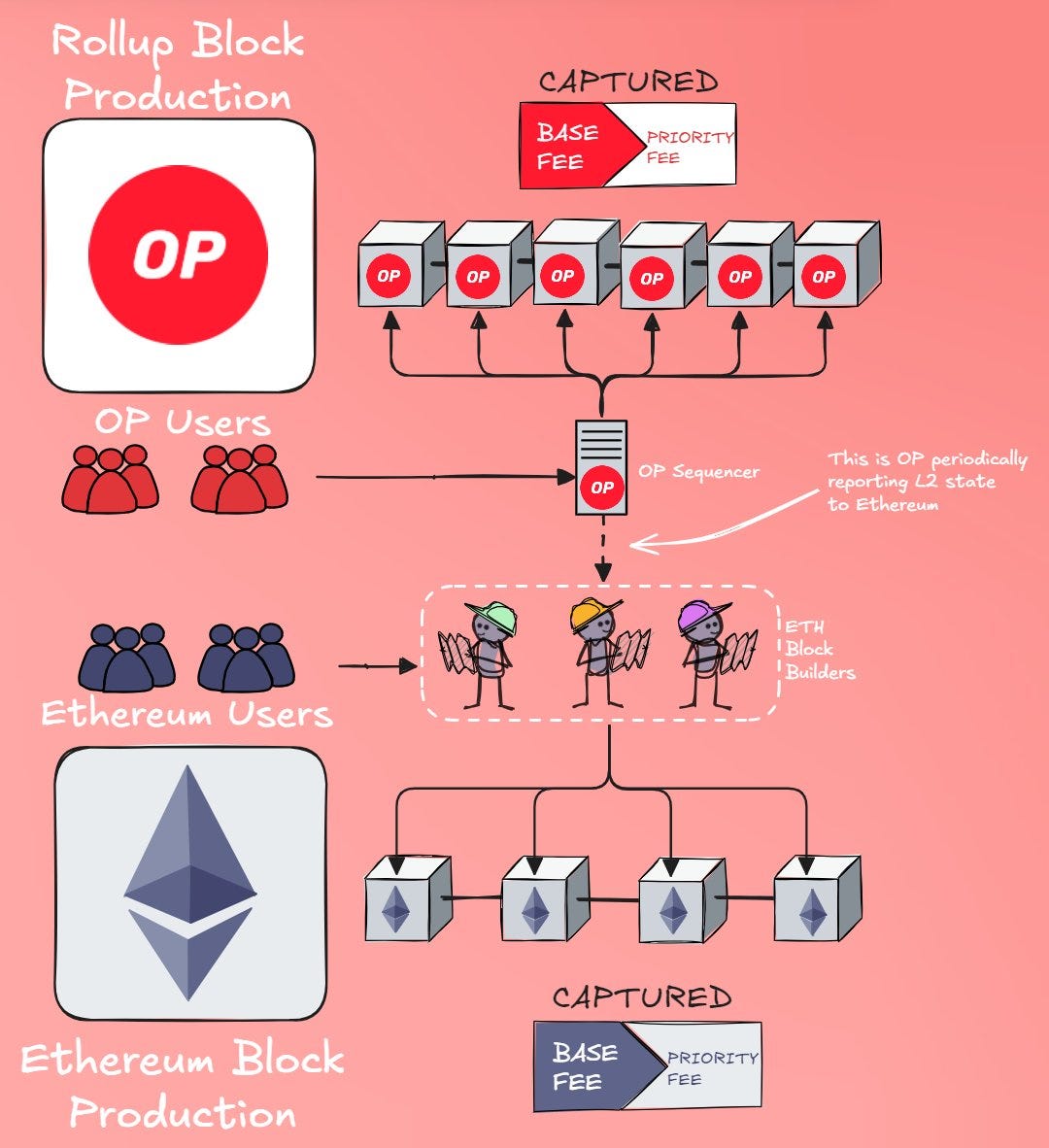
As you can see, not much has been added to the two separate block-building processes in order to tie them together (a single line).
That line represents L2 sequencers periodically posting data to Ethereum mainnet so that the L2 can offer some security guarantees to the L2 users (like forced inclusion).
Note: Ethereum can do nothing to dictate when transactions are posted by any given L2, which means the cadence and efficiency of their posting is entirely in the hands of the submitters.
All-in-all it's pretty one-sided in favor of traditional L2s, who both capture all of the fees generated within their ecosystem and control their single largest expense (posting to mainnet) due to it being at-will.
INTERMISSION, REVIEW
Alright, we're done laying the foundation for the unveiling. Reminder of the most important concepts of the traditional concepts so that we can hone in on Based differentiators:
Ethereum block are built by competing, unaffiliated parties
Traditional rollup blocks are built by sequencers run by rollup teams
Each block-building process captures 100% of its own fees within that ecosystem and Ethereum/L2s are linked by an at-will L2 posting cadence
Now, lets get Based™️
Based Rollup + Ethereum Blocks
The reason we don't need to start off with a Based-only graphic is because, well; Based constructions are relatively simple (which is what makes them elegant).
They ask the question "Why don't we just use Ethereum as our sequencer?"
...and so they do by utilizing the Builders from our Ethereum block building section.
Visualized using @taikoxyz:
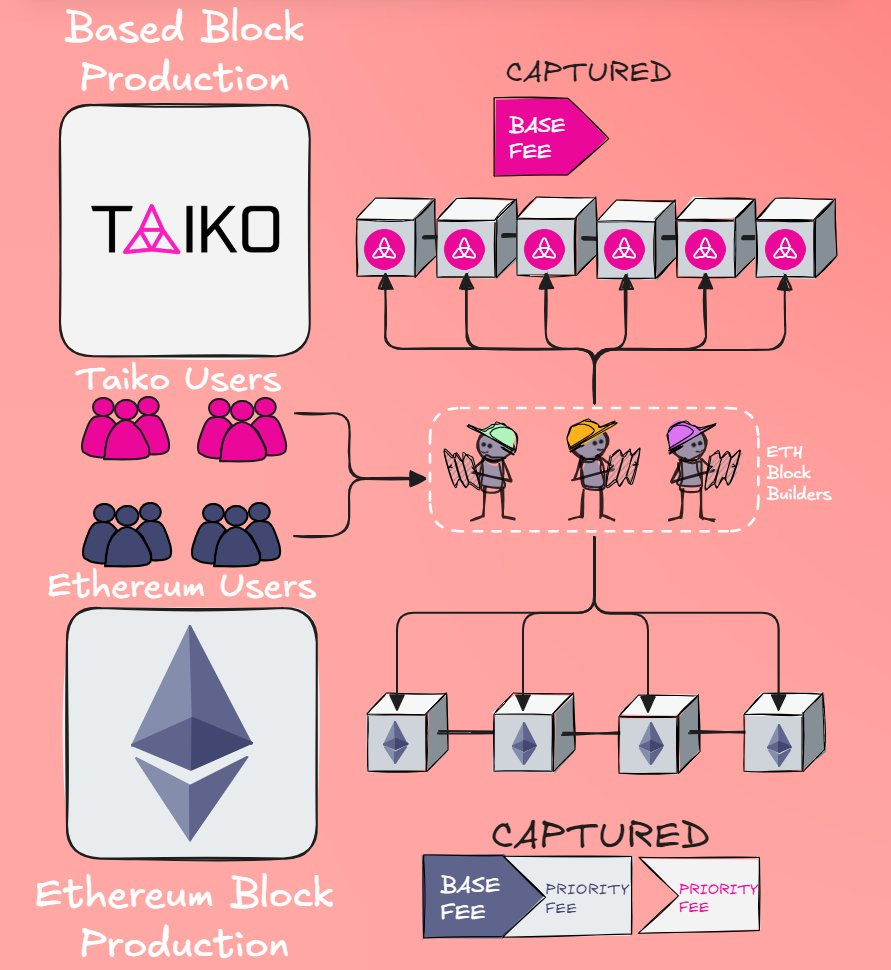
How does this work, you ask? The flow itself is not too dissimilar to a traditional rollup, but the user experience has some nuances.
Flow
Users send their transactions to L1 builders who have opted to perform block building for both Ethereum and the Based L2.
Users specify their max fee
L2 captures the Base Fee (determined by L2 congestion) and passes on the Priority Fee/Tip to L1 Builders, who are responsible for ordering.
In this paradigm Ethereum not only captures 100% of its own ecosystem's fees, but also a portion of the L2 tips on top of the posting costs for settlement.
In exchange for this, the Based L2 inherits:
Ethereum Liveness (i.e. so long as Ethereum is processing blocks so to will the Based L2 whereas if the single sequencer goes down for a traditional rollup then the chain likely halts), and
The ability to become atomically composable with L1 state (e.g. a swap on L2 can interact with L1 liquidity).
It's not without cons though, as being so intertwine with Ethereum means Based teams sacrifice some profitability (Priority Fees) and must also take on the headwinds associated with Ethereum mechanisms (like it's 12s blocktimes).
These things can be mitigated with mechanisms like pre-confirmations, but nonetheless must be considered.
REVIEW, PROJECTIONS
So, are Based Rollups the answer to all of our L1<>L2 economic relationship woes and the future of Ethereum?
Maybe...?
I'm actually skeptical that many teams will opt in to using Based because it directly cuts in to their bottom lines as a business. Thankfully, some of their advantages (L1 atomic composability) are attracting builders so we can at least see the experiments playing out.
There is also an interesting line of research taking place between @gwyneth_taiko and @Spire_Labs, dubbed "Next-Gen Based" where they emphasize L1 applications running their own Based appchains, capturing Priority Fees and remaining composable with L1 contracts. Something I'll be monitoring closely.
Had the Ethereum rollup ecosystem started out Based then I do believe it'd be in a much better narrative position than it is today, but c'est la vie.
Thanks for coming to my Bread Talks.